
Cart
0
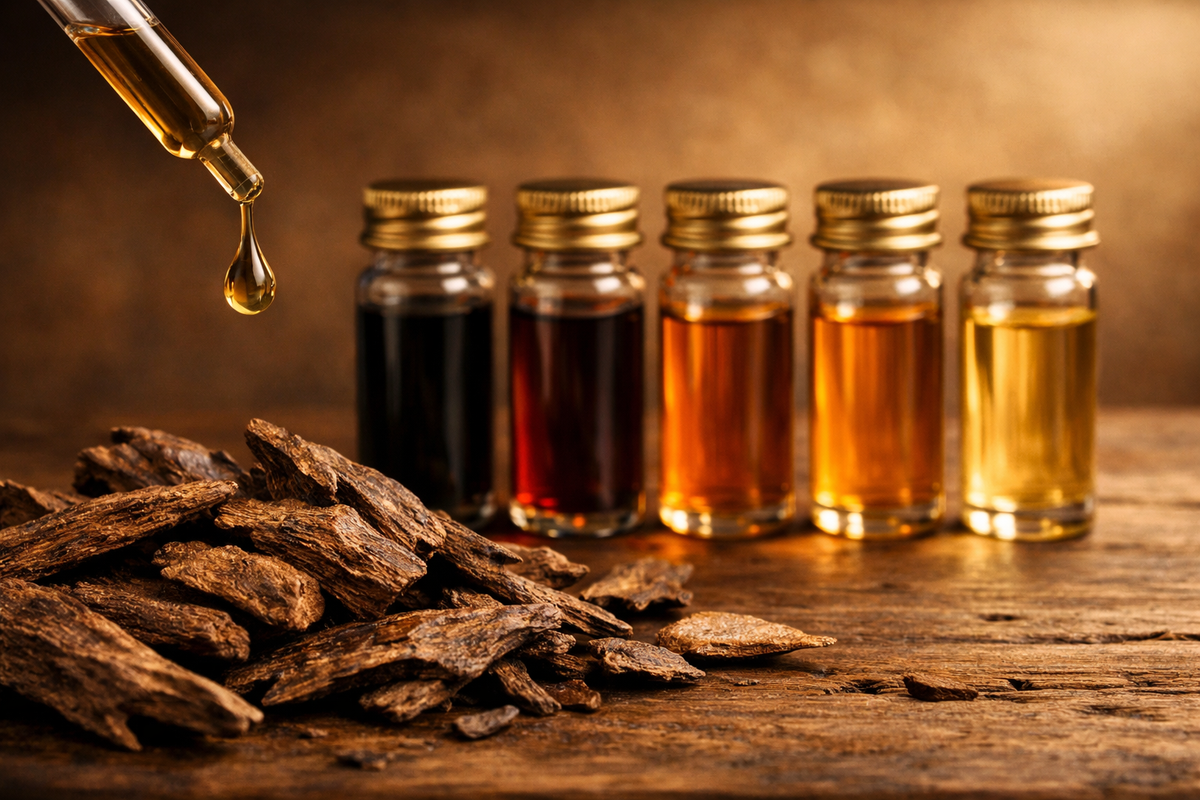
When selecting oud oil, names such as Super, Double Super, Qadeem, and Maliki can be confusing. So what does each of these names mean, and how do you know which is which?
Oud oil grades explained: The grading of oud oil is a non-uniform system. A few names indicate the source or the age of the oil; others are based on the seller's classification or the name of the product. One label may have more than one meaning for different sellers.
The oils in our collection are identified by different names at SA by Saeed Anwar. This guide will explain these labels in a simple way and help you understand their meaning and what you should ask before selecting the oud oil.
1. Why Grade Is Confusing: Four Different Things Share One Word
Study the names of oud oils, and you will realize that they're not all referring to the same thing. Some are used to denote a location, some to indicate age, and others to segment items in a seller's line of products.
There are four big points to remember when reading these labels.
|
What the label describes |
What it generally tells you |
Common examples |
What it cannot tell you alone |
|
Origin |
Where the agarwood grew or was sourced |
Hindi, Cambodi, Burmi, Malaysian |
Whether the oil is high quality |
|
Age |
A claim about maturity or time spent resting |
Qadeem |
The exact age without supporting details |
|
Tier |
A seller's ranking within its range |
Super, Double Super, Triple Super, A, AA, AAA |
Its position in another seller's range |
|
Style or trade name |
A traditional or branded description |
Maliki, Suyufi, Kalakasi |
A measurable quality score |
These categories can appear together on the same bottle. A seller might use a regional name alongside a tier, while another might choose a name linked to age or character.
This is why oud oil quality grades can be difficult to compare. Before deciding which oil is worth trying, work out what the name actually describes. That simple step will help you read the label without assuming that every term represents a higher or lower level of quality.
2. There Is No Single Official Oud Grading System
There is no one grading scale for every seller to follow when selling oud oil. Each company chooses and characterizes oils in its own way. Others are judged entirely by the graders who have extensive experience in grading, including qualities like odour, colour, and physical qualities.
Some bottles may have letters, numbers or descriptive names. The labels are not necessarily comparable, although each system can make sense within the business in which it is used.
|
Grading method |
How sellers use it |
What buyers should know |
|
Letters, such as A, AA and AAA |
Rank oils within a range |
The same letter may mean different things elsewhere |
|
Descriptive tiers, such as Super and Double Super |
Separate products into named levels |
Each seller decides what these terms mean |
|
Numbers, such as 1 to 5 |
Create a numbered ranking |
Check which end of the scale represents the highest level |
|
Producer-defined criteria |
Set out specific features used for grading |
The criteria apply to that producer, not necessarily the wider trade |
Some producers use lab tests like GC-MS to check an oil’s chemical makeup. These tests provide useful details, but they do not give the oil a universal quality grade.
When looking at an oud grading system, ask the seller how each grade is decided. If they use the name Double Super, they should explain what makes that oil different.
Without clear details, the label only tells you so much. It may show where the oil sits in a seller’s range, but it does not mean another seller’s Double Super oil will be the same quality.
3. Origin Names: What Hindi, Cambodi, Burmi and Malaysian Tell You
Origin names are common throughout the oud trade. They describe the region associated with the source material, although the level of detail provided can vary from one seller to another.
Here are four names you may find on product labels:
● Hindi: A traditional trade name associated with Indian oud. Some products identify a more specific source, such as Assam in India.
● Cambodi: A name associated with Cambodian oud.
● Burmi: A trade name associated with Burmese oud from Myanmar.
● Malaysian: A regional label associated with Malaysian agarwood. Some sellers provide a more specific location, such as Terengganu.
Names like Hindi and Cambodi tell you where oud oil is said to come from, but they don’t explain everything about its quality or production.
Even wood from the same region can produce different oils. The trees, wood quality and distillation process can all affect the final result. So, a regional name alone doesn’t tell you how good an oil is.
If the origin matters to you, ask the seller where the oil comes from. Some sellers can share details about the region, while others may only know the country.
For more details, read our guide on how Cambodi and Hindi oud compare.
4. Age Names: What Qadeem Signals
The meaning of old is generally attached to the word Qadeem. It is also used in the oud trade as a sign of aged or old oil, or oil related to old material.
The difference is that there's a difference between the age of the wood and the resting time of the oil that's being extracted. The oil can be stored after distillation, and Agarwood could have matured before distillation. These are two distinct phases, and one doesn't imply the other.
What Age Can and Cannot Tell You
What it can suggest:
● The seller is describing the oil or source material as old or aged.
● Time may have played a part in the oil's development.
● The product is being presented as having an aged character.
What it cannot establish by itself:
● The exact number of years the wood or oil has aged.
● Whether the oil was distilled recently or long ago.
● Whether the oil is better simply because it is described as old.
Some oud oils are known to develop with time, but the result depends on the oil and how it is stored. A longer resting period does not guarantee a better result in every case.
If a seller uses the word Qadeem, ask what it refers to. Does it describe the wood before distillation, the oil after extraction or both? If an exact age is claimed, ask whether the seller has information to support it.
The name can give you a useful starting point, but it should not replace a clear explanation of the product's history.
5. Tier Names: Super, Double Super and Beyond
Names such as Super, Double Super and Triple Super sound like steps on a quality ladder. Within a seller's own range, they may be used to distinguish oils according to selected qualities or the seller's assessment of each batch.
Those qualities might include richness, resin content, intensity or other features used during selection. However, there is no universal definition requiring every seller to apply these names in the same way.
Super vs Double Super Oud
The distinction between Super and Double Super is dependent on the rules of the seller that grades the horse. One company could use Double Super on a batch that they believe is more flavorful or more developed. There could be another who takes the same name, but based on different selection criteria.
Consider this example:
|
Seller |
Product label |
What the label means |
|
Seller A |
Super |
A particular level within Seller A's range |
|
Seller A |
Double Super |
A higher level under Seller A's own criteria |
|
Seller B |
Super |
A level defined by Seller B |
|
Seller B |
Double Super |
A higher level only if Seller B's system says so |
Oud grades can differ between sellers, even when labels match. When comparing Super vs Double Super oud, ask what sets them apart. Is it resin content, scent or wood quality? The same goes for Triple Super and letter grades.
6. Style Names: Maliki, Suyufi and Kalakasi
Not all oud names can be considered quality indicators. Some names are derived from naming conventions, and others are based on a person's claim to a specific oil.
Examples of oud markets are Maliki, Suyufi, and Kalakasi. They can have differing meanings and be used in different ways; it is best to determine what each seller means by it rather than assuming that each name has a single technical definition.
Maliki Oud Meaning
The name Maliki is often associated with royalty, status, and majesty in traditional naming. SA by Saeed Anwar uses the name for oils described through woody, spicy, and resinous elements.
That description helps explain how the brand presents its product. However, the name itself does not establish a particular resin percentage or a formal quality score.
Suyufi Oud Meaning
SA by Saeed Anwar explains Suyufi as meaning elite in status. Its product description presents Hindi Suyufi through woody warmth and softer floral facets.
Here, the name communicates status within the brand's presentation, while the product description gives buyers more information about its character. It should not be mistaken for a recognised technical grade.
Kalakasi
Kalakasi is another name used in the oud market. Its exact meaning and grading significance should not be assumed without an explanation from the seller.
When you come across a style name, treat it as a product description unless the seller provides clear information showing that it also follows a defined grading method. The name may help identify an oil, but it does not replace the details behind it.
7. What Actually Decides Quality, Whatever the Label Says
The quality of the ouds will depend on the quality of the wood and processing. Agarwood is produced in trees such as Aquilaria in which varying amounts of resin accumulate. This resin saturation can cause the oil to smell different.
Age of the tree and growing conditions also influence. Heat, water, time and distiller's acumen all affect the outcome of distillation.
The scent can change with age and storage, however, older isn't necessarily better. Oil can be sourced from any one or be a blend, and this isn’t a guarantee of quality.
|
What the label says |
What matters behind the label |
What you can ask |
|
High grade |
Source material, resin development and distillation |
How does the seller define this grade? |
|
Aged or Qadeem |
The age of the wood and the time the oil has rested |
What exactly has been aged? |
|
Pure |
Whether the oil is single-origin or contains other oils |
Is it single-origin or blended? |
|
Rare or Royal |
The seller's intended description |
What specific details support the description? |
The best way to understand a grade is to look at the information behind it rather than relying on a single word. If you are interested in the wider factors that affect oud prices, read our guide on what drives oud prices.
8. Reading a Real Range: How We Name Our Own Oils
SA by Saeed Anwar uses different names to distinguish the oils in its collection. These names belong to the brand's own product range; they are not part of an official industry-wide grading scale.
The product descriptions offer useful details about the oils, but they do not publish a complete technical grading formula. The examples below explain what the brand's listings state without adding claims that have not been confirmed.
Hindi Double Super
Hindi Double Super is indicated as the product in the product listing and is produced in Assam, India. It talks about its durability and persistence and suggests that the oil can be used in mild, hot, and humid conditions.
The name is a combination of an origin label and a tier name. The origin refers to the "source" that is claimed, and Double Super puts the oil into the naming mechanism of the brand. The public description is not intended to provide the specific criteria used to place that tier.
Read the current listing for Hindi Double Super for the product details.
Hindi Suyufi
SA by Saeed Anwar explains Suyufi as meaning elite in status. Its product description presents the oil through woody warmth and softer floral facets, with oud and floral notes at the opening, musk and oud in the middle, and a woody oud base.
This is an example of a name associated with status and a particular product character. It does not establish a technical grade that can be compared directly with similarly named oils from other sellers.
Check the listing for Hindi Suyufi for current product information and availability.
Maliki
The Maliki listing describes the oil through woody, spicy, and resinous elements. Its presentation centres on the traditional ideas of luxury and majesty associated with the name.
The description helps buyers understand how the brand presents the oil, but it does not provide a numerical quality score or a formal grading formula.
You can read the current details for Maliki.
Hindi Qadeem
According to the Hindi Qadeem listing, the oil was distilled in Northern India many years ago and has been naturally aged. It says it has an earthy, warm, woody/leathery, and smoke-like aroma character.
This product is a demonstration of associating a name with age. The specific description is based upon the brand's listing and, by itself, is not sufficient to create the same history for another oil.
For the product's published details, visit Hindi Qadeem.
Dehn Al Oud Cambodi
The product listing presents Dehn Al Oud Cambodi as Cambodian oud. Its description mentions spicy opening notes, warmer and slightly fruity facets, and a woody dry down.
The name identifies the claimed origin, while the description explains how the fragrance is presented. It does not establish a universal grade or a ranking against oils from other regions.
Read the current listing for Dehn Al Oud Cambodi.
These examples show how product names can combine different kinds of information. An origin name, a tier, or a traditional style name each serves a different purpose, so it is worth reading the full description rather than judging a bottle by its title alone.
9. Five Questions to Ask Before You Pay for a High Grade
A high-grade label sounds impressive, but ask a few questions before buying. You can also learn how to tell real oud from fake.
Ask the seller these five questions:
- Origin: Which country or region does the oud come from?
- Grade: How do you define Super and Double Super?
- Source: Is the oil single-origin or blended?
- Age: Does Qadeem refer to aged wood or oil?
- Scent: How does the fragrance change on skin over time?
Clear answers make choosing easier. If you're still unsure, try our oud oil testers before buying a bottle.
10. Frequently Asked Questions
Is a higher grade always better?
Not automatically. A higher grade may reflect a seller's preferred selection criteria, but the label alone cannot tell you whether the oil is right for you. Consider the product description and your own experience rather than treating the highest tier as the automatic winner.
Can a lower-tier oud still smell good?
Yes. A lower-tier label does not mean an oil cannot have an appealing fragrance. The tier reflects the seller's ranking, not a universal judgement of whether the scent is enjoyable.
Why do two shops charge very different prices for the same-named grade?
The name is not standardised, so two sellers may use it for oils with different characteristics. Their sourcing, production arrangements and business costs may also differ. The shared label does not prove that the oils are equivalent.
Does oud oil change as it ages in the bottle?
It can. Some oud oils are described as becoming smoother or developing different facets over time, but changes vary from one oil to another. Storage conditions also matter, so ageing should not be treated as a guarantee of improvement.
Is a higher grade better for everyday wear?
Not necessarily. The tier name does not tell you whether an oil will suit every setting. Consider the product's described character and try a sample in the situations where you expect to wear it before choosing a full bottle.
Final Thoughts
Knowing the meaning of each name will help you understand each label of Oud. Each of these (Origin, age, Seller-supplied tiers, and style names) gives a different kind of information; none of them is a criterion of quality alone.
Read the product description and ask clear questions, and use a sample if available. Shop our pure oud collection, see the options, and then select an oil with a better understanding of the name


