
Cart
0
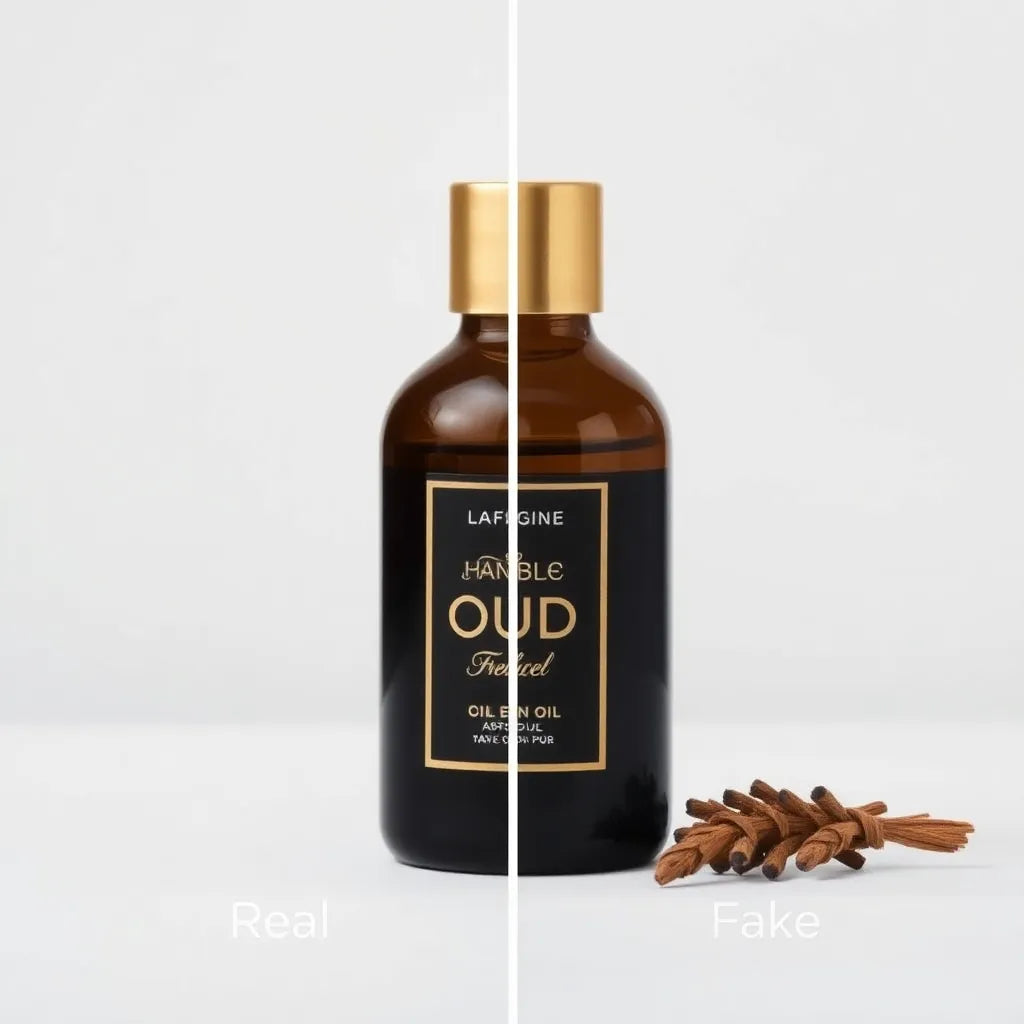
Oud oil, also known as liquid gold, is a fragrant resin extracted from the Aquilaria tree when it becomes infected with a particular mold. This natural reaction creates an intensely aromatic resin that's distilled into one of the most luxurious perfumes in the world.
Its value spans cultures and centuries, revered in Middle Eastern traditions, deeply spiritual in South Asia, and a growing obsession in Western niche perfumery. But with demand comes deception. As the oud market expands, so does the influx of synthetic and fake oils.
That's why knowing how to differentiate authentic oud oil vs synthetic is essential, not just for your nose, but for your investment.
This guide is written by the team at Saby Saeed Anwar, who work with pure oud oils every day. We sell oud, so we have a stake in this topic. That is exactly why this guide focuses on checks you can run yourself, on any brand, including ours.
Quick Answer: How to Tell Real Oud Oil From Fake
• Check the label first: Real oud is sold as pure agarwood (oud) oil. Wording like "oud-inspired," "oud blend," or "oud fragrance oil" usually means the product is not pure distilled oud.
• Check the price: Genuine oud takes years to form and is distilled in small quantities. A very low price for "pure oud" is the biggest red flag.
• Watch the scent over time: Real oud changes from the first minute to the dry-down hours later. Fake oud tends to stay one loud, flat note.
• Look at seller transparency: A trustworthy seller can tell you the origin, species, and distillation method, and can often share a lab report.
• Remember no single home test is proof: Use several checks together, and when in doubt, buy a small sample first.
What is Oud Oil and Why Is It So Prized?
If diamonds are forever, oud is eternal, in scent, soul, and value.
So, what is oud oil? It is extracted from the resinous heartwood of Aquilaria trees, primarily found in Southeast Asia and parts of South Asia such as Assam. The magic begins only when the tree becomes infected with a specific type of mold, triggering it to produce a dark, aromatic resin as a defense mechanism. You may also see it called agarwood, oudh, or agar. These all refer to the same raw material.
This resin-rich wood is then distilled into one of the most precious oils in the world. Because wild Aquilaria trees are threatened, the species are protected under CITES, which is one more reason genuine oud is scarce and costly.
But why is oud oil so prized?
• Culturally: It's deeply rooted in Middle Eastern, South Asian, and East Asian rituals.
• Spiritually: It's believed to elevate meditation and prayer.
• Commercially: It's rare and expensive. Some authentic oud oils sell for thousands per tola (a traditional South Asian unit of about 11.66 grams).
And when it comes to authentic oud oil vs synthetic, the difference isn't just in the scent. It's in the entire experience. Synthetic oud perfumes might smell strong, but they lack the depth, evolution, and soul of the real deal. That's why knowing how to tell the difference is crucial.
How to Identify Pure Oud Oil: Key Characteristics to Look For
Your first clue is in the bottle. Real oud doesn't try too hard to impress, but it never fails to leave a mark.
When you know what to look for, spotting pure oud oil becomes a skill, and a satisfying one at that. Here's what defines the best:
• Color: Real oud oil usually ranges from golden amber to deep brown, depending on its origin, age, and distillation. If it looks unusually bright, perfectly clear, or oddly colored, ask more questions. Color alone is never proof.
• Consistency: Think thick, syrupy, and slow-moving. Many authentic oils cling to the walls of the glass bottle when tilted, though lighter distillates can be more fluid.
• Scent: Authentic oud oil is not a one-note song. It's deep, woody, smoky, slightly sweet, and evolves as you smell it. It's complex and never overpowering in a synthetic way.
If the oil feels too light, smells too sharp, or looks oddly colored, your instincts might be right. For a sense of what a genuine, labelled product looks like, browse our pure oud oil collection.
The Scent of Real Oud Oil: What Should You Expect?
If scent were a story, real oud oil would be a thousand-page novel.
The smell of real oud is hypnotic. It starts off earthy and slightly animalic, then unfolds into smoky, leathery tones before settling into a rich, warm trail that lasts for hours, sometimes even days, on your skin.
Even better, oud oil reacts to your skin's chemistry, making it personal. What smells woody on one person might turn sweet and balsamic on another. This evolving nature is a signature trait of authentic oud.
Synthetic oud oils, in contrast, tend to hit one loud note and stay there. No evolution, no journey, just perfume fatigue.
Natural Oud vs Synthetic Oud: What's Actually Different?
Many people search for "synthetic oud oil" or "synthetic oud" without knowing what it really is. Here is the plain explanation.
Natural oud comes from distilled agarwood. Its aroma is the result of hundreds of naturally occurring compounds, including sesquiterpenes and chromones, which is why it shifts so much over time.
Synthetic oud is built to imitate that smell. Perfumers combine aroma chemicals with natural woody materials such as guaiac wood, patchouli, or cypriol to create an "oud accord." The exact formulas are proprietary, so you will not find a public "synthetic oud formula," but the idea is always the same: recreate the impression of oud without using agarwood.
• Origin: Natural oud is distilled from infected agarwood. Synthetic oud is composed in a lab or perfumery.
• Aroma over time: Natural oud evolves for hours. Synthetic oud is usually linear and strongest in the first few minutes.
• Cost: Natural oud is expensive because of scarcity. Synthetic oud is far cheaper to produce.
• Honesty of labelling: Synthetic oud is not automatically bad. Many good perfumes use it openly. The problem is only when it is sold as pure oud.
Blended products are also legitimate when they are labelled honestly. For example, oud mukhallats combine oud with other natural ingredients, and an attar can be pure oud diluted in a sandalwood base. What matters is that the label tells you exactly what you are buying.
Differences Between Real and Fake Oud Oil: How to Spot the Fake Ones
Spotting a fake is easier when you know what real beauty looks like.
Here's how to break down real vs fake oud oil:
• Fragrance: Fake oud oil usually smells loud, linear, and artificial, sometimes like burnt rubber or synthetic musk.
• Consistency: Cheap oud or fakes are often thin, watery, or feel greasy. Real oud has a heavier, more luxurious texture.
• Price: Let's be real, if it's too cheap, it's not real. True oud oil takes years to develop and distill. If someone offers you "pure oud" for $20, walk away.
Look out for buzzwords like "oud-inspired" or "oud blend." These are often a sign that you are not buying pure oud.
Testing Oud Oil Purity: Methods to Confirm Authenticity
You don't need a lab coat to test your oud, just a few smart techniques. Treat these as clues, not courtroom evidence.
Want to check if your oud is the real deal? Try these easy at-home methods:
• Smell Test: Apply one drop on your skin and wait. Real oud evolves over time, layer by layer. If it smells exactly the same after 30 minutes, it's likely synthetic. For best results, apply it on clean, moisturised skin and don't rub it in, since rubbing can break down the delicate top notes.
• Dry-Down Test: Check the scent again after 6 hours and again the next morning. Real oud keeps developing and often lingers faintly on fabric the next day.
• Consistency Test: Rub a drop between your fingers. Real oud feels thick and resinous, not runny or slick like many carrier-based versions.
• Water Test (low reliability): Some people drop oil into water and watch how it behaves. Almost all oils float and separate from water, including fakes, so this test cannot prove authenticity. Use it only as a minor extra check.
The most reliable proof is a lab report. Reputable sellers can sometimes provide GC-MS (gas chromatography–mass spectrometry) analysis, which identifies what is actually in the oil.
Remember: real oud oil doesn't shout. It whispers in layers.
Real vs Fake Oud Oil: Chemical and Physical Differences
Under a microscope, the truth about your oud gets even more fascinating.
Authentic oud oil is derived through slow hydro- or steam distillation of aged, resin-rich wood. Its chemical profile contains rare sesquiterpenes and chromones that are very hard to replicate convincingly in a lab.
Fake or diluted oud oils, on the other hand, are often loaded with chemical additives, alcohols, or cheap filler oils that mimic oud's top notes but lack its depth and evolution.
Distilled oud oil vs blended versions aren't even in the same league. One is artisanal, the other is manufactured.
How to Tell if a Branded Oud Perfume Is Original or Fake
Many people search for "original vs fake" for popular names such as Oud Al Layl, Oud Madness, Ameer Al Oud, Oud De Arabia, Oud Mood, or Dirani oils. We are not affiliated with these brands, and packaging changes between batches, so always compare against the brand's own current photos. These checks apply to any branded oud perfume or oil:
• Buy from an authorised seller: Use the brand's official store, its listed distributors, or a retailer that can show supply-chain proof.
• Check the batch code: Genuine boxes usually carry a batch or production code that matches the bottle. Missing, smudged, or mismatched codes are a warning sign.
• Inspect the box and wrapping: Look for blurry printing, spelling errors, uneven cellophane seams, and flimsy cardboard.
• Inspect the bottle: Check cap fit, label alignment, glass quality, and sprayer. A weak, uneven, or dripping spray is common in fakes.
• Compare the scent with a tester: Smell a tester from an authorised store, then compare the opening and the dry-down on your skin.
• Be wary of deep discounts: A price far below the normal market range deserves a question, not a purchase.
• Ask for an invoice: A legitimate seller can provide proof of purchase and a return policy.
How to Avoid Buying Fake Oud Oil: Trusted Sources and Tips
The best way to avoid fake oud? Know your source like you know your scent.
The world of oud is full of treasure, and traps. To make sure you're getting the real thing:
• Buy from certified, reputable suppliers who specialize in oud, not general perfume stores.
• Look for transparency: origin, distillation method, and species should all be disclosed.
• Avoid mass-market deals. Real oud is a luxury commodity. It's not meant to be sold in bulk at suspicious prices.
• Read independent reviews and check how the seller handles returns and questions.
Specialist brands like Saeed Anwar Signature Oud Fragrances are safer bets than anonymous marketplace sellers, but hold every seller, including us, to the same standard of transparency.
How to Choose Pure Oud Oil: Buying Tips for Beginners
Buying your first oud? Here's how to make it count, not regret it.
Here's what to check before you buy:
• Origin: Oud from Assam, Cambodia, or Borneo often has a higher value. Each region has its own scent profile, so learn what you love.
• Product type: Know the difference between pure oud oil, oud attar in a sandalwood base, and oud blends. Each is valid, but they are priced and used differently.
• Packaging: Pure oud should be stored in airtight glass vials. Plastic containers degrade its quality.
• Vendor Transparency: If the seller can't tell you where the oud comes from or how it's made, it's time to walk away.
Start small with samples, test them over a few days, and educate your nose. Our oud collection includes options at different price points to start with. You'll be an oud connoisseur in no time.
Why Identifying Real Oud Oil Matters for You
In a world full of fakes, knowing the real thing is a superpower.
From cultural rituals to luxury perfumes, oud carries a legacy that deserves respect. Whether you're buying for personal use or spiritual practice, remember: real oud oil isn't just a fragrance, it's a journey. And that journey begins with sourcing right, testing smart, and trusting your senses. When you're ready, explore genuine oud oils and start with a small sample.
Frequently Asked Questions About Real vs Fake Oud
How do I know if an oud perfume I'm buying is 100% authentic?
Buy from an authorised seller, check that the batch code on the box matches the bottle, inspect the packaging and sprayer quality, and compare the scent against a tester. If the price is far below the market, be cautious.
What are the tell-tale signs of a fake or counterfeit oud perfume?
Common signs include blurry or misspelled packaging, missing or mismatched batch codes, a weak or uneven sprayer, a scent that is flat or harsh right after spraying, and a price that is too good to be true.
Do authentic oud perfumes smell different from fakes on the first spray?
Often, yes. Authentic oud perfumes usually open with more depth and complexity, while fakes tend to be sharper and one-dimensional. The real difference shows in the dry-down over several hours, so don't judge on the first spray alone.
Which oud perfumes are most commonly counterfeited?
Popular, widely sold oud perfumes are the most frequent targets, because counterfeiters copy what sells. We can't verify individual brand claims, so check the official website of the brand you are buying for authenticity guidance.
How can I verify the authenticity of an oud perfume before purchasing online?
Check that the seller is listed by the brand as an authorised retailer, look for a clear return policy, ask for batch details and real product photos, and read independent reviews. Avoid sellers who hide their company details.
Are sale-priced oud fragrances always authentic?
No. Genuine sales happen, but a deep, unexplained discount is a common counterfeit signal. Compare the price against the brand's own store and look for a reason for the discount, such as a seasonal sale from an authorised seller.
Is buying oud from an official retailer always safer than from a third party?
It is usually safer, because the supply chain is traceable. A reputable third party can still be genuine, but you must check their reviews, return policy, and proof of authenticity.
How do I know if a niche oud brand is authentic and high quality?
Look for clear information about origin, ingredients, and production method, consistent packaging, real customer reviews, and willingness to share lab data or answer detailed questions.
Can oud smell completely different depending on the brand?
Yes. Oud varies by species, region, age, distillation method, and what it is blended with. Two real ouds can smell very different, so a different scent does not automatically mean a fake.
Why does buying authentic oud matter beyond just quality?
Genuine oud supports traditional distillers, and counterfeits may contain undisclosed ingredients that can irritate sensitive skin. You also avoid paying a premium price for a cheap imitation.


