
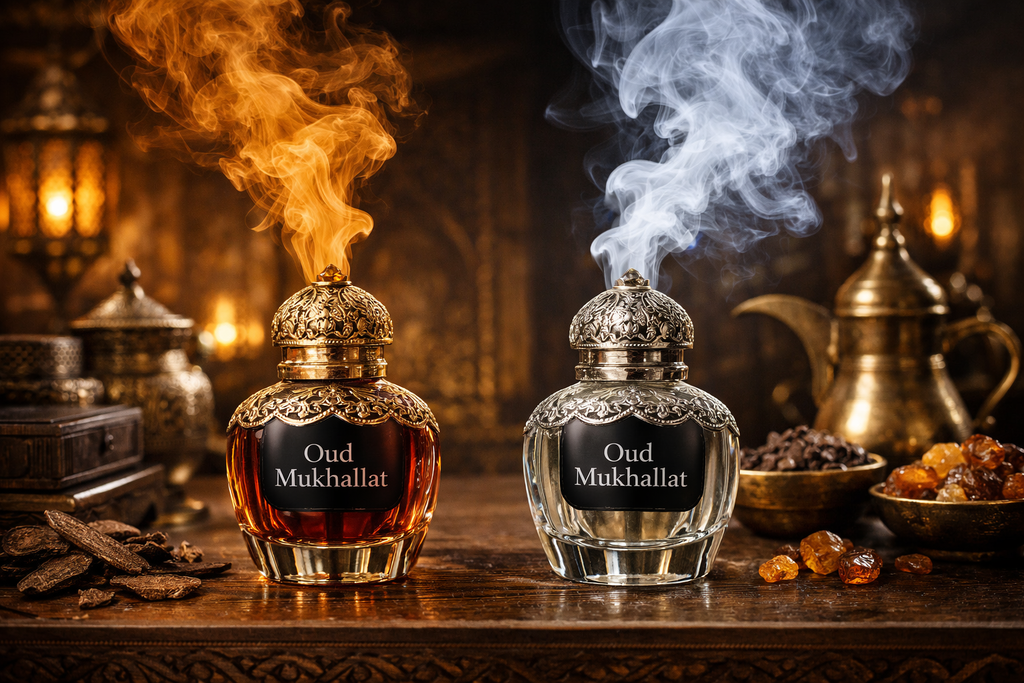
Why Does One Oud Mukhallat Smell Stronger Than Another?
Have you ever tried two oud mukhallats and noticed a big difference between them? Both may be described as an oud blend, yet one can stay on your skin for hours while the other seems to disappear fairly quickly.
That can leave you wondering: why is one oud mukhallat stronger than another?
There isn't one simple answer. The strength of a mukhallat depends on several things, including the amount of oud oil used, the quality of the oud, the other oils added to the formula, and the time given to the blend before it is bottled.
This is where mukhallat concentration explained in simple terms, can make choosing a fragrance much easier. Instead of judging a bottle only by its name or price, you can look at what is actually inside it.
At SA by Saeed Anwar, we believe understanding these details makes it easier to appreciate the work behind every blend. So, let's look at what makes one mukhallat feel stronger than another.
It Starts With the Oud-to-Carrier-Oil Ratio
The first thing to consider is the amount of oud oil used in relation to the carrier oil.
The mukhallat, in general, is not a spray that is made of alcohol. The carrier oil dilutes and transports the aromatic ingredients, and the fragrance oils give the fragrance. Carriers can be materials such as jojoba oil and oils based on sandalwood.
Imagine making tea. If you are making a cup of tea, make sure there are lots of tea leaves in a cup of water, and it will be stronger. The amount of drink used will determine whether it is lighter when used in small quantities. It is the same when it comes to an oil perfume.
The higher the ratio of aromatic oils to the carrier oil, the fuller and stronger the smell will be. A mixture that has more carrier oil may be easier on the skin.
This is quite unlike how most people describe the strength of a perfume. If you're using perfumes with alcohol, you'll likely find words like Eau de Parfum or Extrait de Parfum that refer to how concentrated the fragrance is. The percentage system is not always consistent with blends of oils.
That doesn't mean a highly concentrated mukhallat is automatically better. Some people prefer a soft scent that stays close to the skin, while others want something that can be noticed from a distance.
You can explore our oud mukhallat collection to see how different oud blends can have their own character and strength.
The Base Oud Grade Sets the Ceiling
The quality of the oud used at the beginning of the blend also matters.
This is where base oud grade quality becomes important. Oud isn't a single type of oil with the same smell every time. Its character can change depending on the source of the wood, the species of agarwood, how the material was prepared, and the distillation method.
Some oud oils have a dark, deep, and earthy character. Others can be sweeter, greener, woody or even slightly smoky. Their strength can also vary.
Indian oud, often referred to as Hindi oud, is known for its rich and distinctive character. Cambodian oud can have a different profile, sometimes with sweeter or fruitier qualities. These are broad descriptions, though, because individual oils can vary considerably.
A blend made with a naturally rich oud oil has more depth to work with from the start. Supporting ingredients can change its character, but they cannot completely replace the qualities of the original oud.
This is why two mukhallats containing oud can smell completely different even when their ingredient lists look similar.
If you want to experience oud without a large number of supporting notes around it, you can explore our pure oud collection.
Why Maturation Time Changes Everything
There is another part of the process that people often overlook: time.
A newly mixed fragrance doesn't always smell exactly the way it will after it has rested. At first, individual oils can stand out quite strongly. One note may seem sharp, another may appear unusually sweet, and the whole blend can feel slightly disconnected.
This is where the mukhallat aging process comes into the picture.
After the ingredients have been mixed, some perfume makers allow the blend to rest before it is bottled. The length of this period can vary. There isn't one rule saying that every mukhallat must mature for a particular number of days or weeks.
As the blend rests, the different materials have more time to settle together. The result can be smoother and more balanced than the freshly mixed fragrance.
It's important to make one distinction here. Maturation doesn't simply mean that a fragrance becomes louder.
Instead, it can change how the fragrance develops. A sharp opening may become softer, individual notes may become easier to notice together, and the overall scent can feel more rounded.
That can also affect what makes mukhallat long lasting. A balanced formula with suitable base materials may remain noticeable on the skin for a long time, although performance will always depend on the individual blend and the person wearing it.
On the About Us page, you can learn more about the approach behind our fragrance craft.
How Many Notes Are Layered Around the Oud
Oud is only one part of many mukhallats. The materials blended around it can have a major effect on the way the fragrance performs.
This is an important part of how mukhallat perfume is made, especially when looking at layered oud notes density.
Some ingredients are naturally heavier and tend to remain on the skin for longer. Amber, musk, and sandalwood are common examples. When these types of notes are combined with oud, they can give the fragrance a deeper base and help it remain noticeable.
Lighter ingredients behave differently.
Citrus notes, fresh accords, and some floral materials can be much more noticeable at the beginning. They may give a blend a bright and pleasant opening, but they can fade sooner than heavier base materials.
This doesn't mean a fragrance containing lighter notes is weak or poorly made. It simply has a different structure.
For example, a mukhallat with oud, rose, and lighter floral notes may feel cleaner and more delicate than a dark blend built around oud, amber, and musk.
The way these materials are balanced is what gives a mukhallat its personality. If you'd like to see how a floral note can work with oud, you can explore Oud Roses.
How to Judge Mukhallat Strength Before You Buy
You don't need to be a perfume expert to make a better choice. A few simple questions can tell you quite a lot about a mukhallat.
When comparing a strong vs weak oud blend, start with the base.
Ask about the oud.
Find out what type of oud is used and, where possible, ask about its origin and quality. A good seller should be able to provide useful information about the materials used in the fragrance.
Look at the supporting notes.
Ingredients such as amber, musk, and sandalwood can give a blend a heavier base. If you prefer fragrances with a strong presence, these are worth paying attention to.
Try it on your skin.
This is probably the most useful step.
A fragrance can smell one way on a paper strip and completely different on your skin. Body temperature, skin type, and even the amount of oil applied can affect how the fragrance develops.
Give the mukhallat some time rather than judging it immediately after application. The opening is only one part of the fragrance.
If you're searching for a pure oud mukhallat Pakistan has to offer, testing different options can help you understand what kind of oud profile you actually enjoy.
You can also use our tester collection to explore fragrances before choosing a full-size bottle.
In the end, fragrance strength isn't simply about finding the bottle with the biggest label or the highest price. It comes from the materials, proportions, blending method, and time that goes into the fragrance.
Once you understand those details, it becomes much easier to choose a mukhallat based on what you actually want to wear.
Frequently Asked Questions
Why does one mukhallat smell so much stronger than another?
Several factors can cause the difference. The amount of oud oil compared with carrier oil is one factor, while the quality of the base oud, the maturation time, and the supporting ingredients also play a role. Heavier materials such as amber and musk can make a blend feel deeper and more persistent.
Does a stronger mukhallat mean better quality?
Not necessarily. Strength and quality are two different things. A strong fragrance may have excellent materials, but it can also be unbalanced if the ingredients don't work well together. A softer mukhallat can be carefully made and still offer a beautiful fragrance experience.
Why do some mukhallats need time to "develop" before they smell their best?
Freshly blended oils may smell quite different from a blend that has been allowed to rest. Giving the fragrance time can help the different ingredients settle together. As a result, some of the sharper parts may soften, and the overall scent can become smoother.
Is a mukhallat always weaker than pure oud oil?
Generally, a mukhallat is more than just pure oud because it combines oud with other fragrance materials and, in many cases, a carrier oil. However, this doesn't mean every mukhallat will feel weak. An oud-forward blend can still have strong projection and good staying power.
How can I tell if a mukhallat is well-formulated before buying?
Start by asking about the oud used in the blend and its origin. You can also look at the supporting notes and consider whether they match the type of fragrance you enjoy. Most importantly, test the fragrance on your own skin if possible. Your skin can change how the oils smell and how long they remain noticeable.
أحدث المنشورات
27.September.2026


