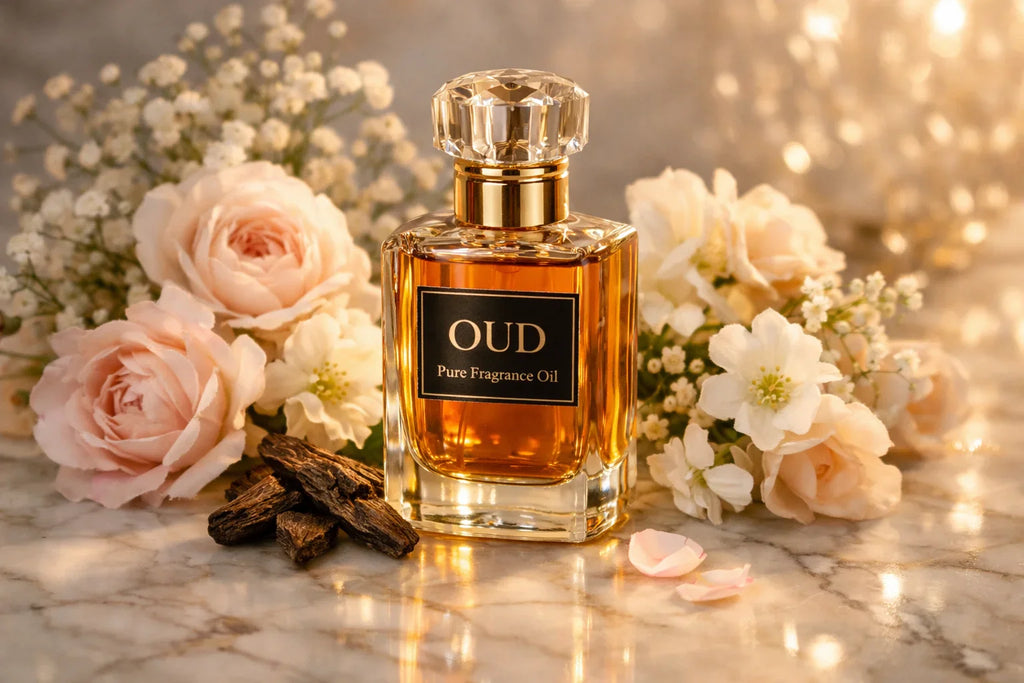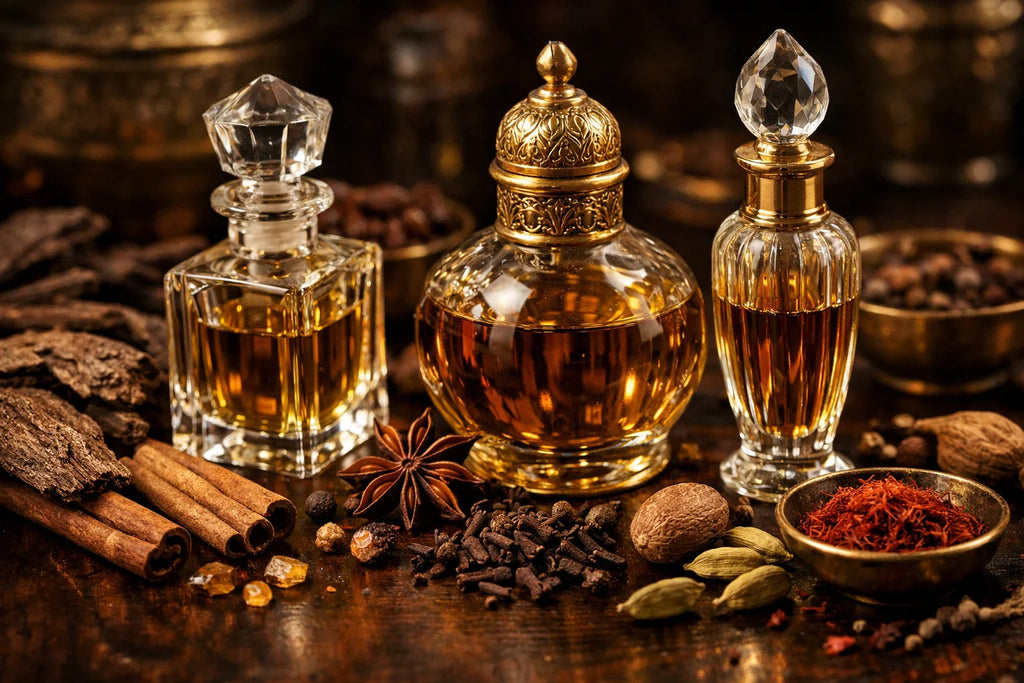

What Does Oud Smell Like? A Deep Dive into the Scent of Liquid Gold
Oud smells woody, smoky, earthy, and deeply complex. It carries notes of ancient forest, sacred incense, balsamic resin, and subtle musk. The scent evolves on your skin over time starting sharp and smoky, then warming into a rich, velvety base that can last for hours or even days. No two people smell oud exactly the same way, because it reacts uniquely with each person's body chemistry.
There's a reason why oud is often called liquid gold. Its scent isn't just another note on a fragrance chart — it's a sensory journey. One drop transports you to ancient temples, dense rainforests, and rituals steeped in smoke and mystery.
But if you've never smelled oud before, describing it is like trying to explain colour to someone who has never seen. Is it woody? Smoky? Sweet? The answer is yes — and so much more.
Let's take an immersive journey into the world of luxury fragrance oil, oud: what it is, how it smells, why it's adored across cultures, and how you can choose the right one.
What is Oud? The Origin and Meaning Behind the Scent of Agarwood
To truly understand what is oud, we have to look at its origin. Oud, also known as agarwood, is a resin that forms when the Aquilaria tree — native to Southeast Asia — becomes infected with a specific type of mould. The tree reacts by producing a dark, aromatic resin known as oud or agarwood, transforming decay into a divine substance.
But the agarwood meaning goes far beyond biology. In Islamic, Hindu, and Buddhist cultures, oud has been burned in religious rituals for centuries. It symbolises purification, spiritual grounding, and emotional connection.
So, when someone asks "what is oud?", it's more than a perfume ingredient — it's a sacred gift from nature.
What Does Oud Smell Like in Perfume and Attars?
So, what does oud smell like in perfume or attars?
In a word: complex. The oud perfume smell isn't linear — it evolves like a story told in whispers and shadow.
Here are the most common descriptions of the smell of oud oil:
• Woody — Think of an ancient forest drenched in rain, deep, dark, and slightly sweet.
• Smoky — Reminiscent of sacred incense or smouldering embers.
• Earthy — Mossy and grounded with a raw, natural bitterness.
• Balsamic — Smooth and resinous, with subtle medicinal sweetness.
• Animalic/Musky — Intimate, leathery, primal, and bold.
Oud's layered aroma can feel sacred, like a memory passed through generations.
How Does Oud Smell on Skin?
One of the most fascinating things about oud is how differently it behaves depending on who is wearing it. Oud does not simply sit on the surface — it sinks into your skin and evolves throughout the day.
Here is how the oud scent journey typically unfolds on skin:
|
Stage |
Time on Skin |
What You Smell |
|
Top Notes |
First 5–15 minutes |
Sharp, smoky, sometimes medicinal or resinous. Can feel intense at first. |
|
Heart Notes |
15–60 minutes |
Warm, woody, and subtly sweet. The oud begins to soften and bloom. |
|
Base Notes |
1–12+ hours |
Deep musk, amber, and velvety resin. Rich, intimate, and long-lasting. |
Because oud interacts with your unique body chemistry, the same oud oil or perfume can smell noticeably different on two people. This is exactly why oud becomes a truly personal scent signature — it is never just a fragrance, it is your fragrance.
If you are new to oud, always wait at least 20 to 30 minutes after applying before judging the scent. The opening notes can be polarising, but the dry-down is almost universally beautiful.
Real Oud vs Synthetic Oud: What's the Difference in Smell?
Ever loved one oud fragrance but found another too strong or flat? The secret usually lies in the source: pure oud vs synthetic oud.
• Real oud smell: Extracted directly from agarwood, it's rich, evolving, and has an emotional depth. It transforms over time and interacts uniquely with every wearer's skin.
• Synthetic oud: Lab-made, often attempts to mimic the aroma but usually comes across as flat or overly perfumed. It lacks the complexity and the difference in oud fragrance is immediately noticeable.
If you compare the two, real oud is like a live symphony. Synthetic is just the ringtone version.
Types of Oud and Their Unique Fragrance Profiles
Just as wines vary by region, so does oud. The types of oud each carry a signature oud scent profile based on the tree's origin and the distillation process.
Here's a breakdown of the most famous varieties:
• Cambodian Oud: Sweet, warm, slightly fruity, and resinous — perfect for beginners.
• Indian Oud: Bold and animalic, with earthy and musky tones that linger powerfully.
• Thai Oud: Smoky, green, and herbaceous with a medicinal edge.
• Middle Eastern Oud: Dry, spicy, and luxurious — often paired with rose, saffron, or amber.
Your ideal oud fragrance description might just depend on your regional preference.
Indian Oud vs Arabian Oud: Which Smells Different and Why?
Among all oud varieties, the two most debated are Indian oud and Arabian oud. They come from the same Aquilaria family of trees, but the difference in smell is striking. Here is a detailed comparison:
|
Feature |
Indian Oud |
Arabian Oud |
|
Scent Character |
Bold, animalic, and intensely earthy |
Dry, spicy, and refined |
|
Smokiness |
Heavy and deep smoke |
Light to moderate, more elegant |
|
Sweetness |
Low — raw and primal |
Higher — often blended with rose or amber |
|
Musk Level |
Very high — leathery and intimate |
Moderate — cleaner and more polished |
|
Complexity |
Wild and evolving unpredictably |
Structured and luxurious |
|
Best For |
Connoisseurs and bold scent lovers |
Everyday luxury wear and beginners |
|
Common Pairings |
Sandalwood, vetiver, dark musk |
Rose, saffron, amber, vanilla |
|
Price Range |
Very high due to rarity |
High to very high |
In short, Indian oud is raw power it commands attention and is not for the faint-hearted. Arabian oud is refined elegance deeply luxurious but more approachable for those new to the oud world. Neither is better; they serve different moods and occasions.
Oud vs Sandalwood vs Musk: How Do They Compare?
If you are trying to understand where oud sits in the wider world of fragrance, comparing it to two other popular woody and warm scents — sandalwood and musk — is the clearest way to do it.
|
Feature |
Oud |
Sandalwood |
Musk |
|
Scent Family |
Woody, smoky, resinous |
Woody, creamy, milky |
Animalic, soft, skin-like |
|
Intensity |
Very high — bold and commanding |
Medium — soft and gentle |
Low to medium — subtle |
|
Longevity on Skin |
12–24+ hours |
6–10 hours |
4–8 hours |
|
Complexity |
Highly complex, evolves over time |
Moderate, relatively linear |
Simple, stays close to skin |
|
Origin |
Agarwood resin (Southeast Asia, Middle East) |
Santalum tree (India, Australia) |
Originally animal-derived, now mostly synthetic |
|
Price |
Very expensive (pure form) |
Moderate to expensive |
Generally affordable |
|
Best Paired With |
Rose, amber, saffron, vanilla |
Vanilla, jasmine, citrus |
Florals, light woods, citrus |
|
Mood/Vibe |
Sacred, mysterious, powerful |
Calm, warm, meditative |
Clean, sensual, subtle |
|
Beginner-Friendly? |
Moderate — start with blended versions |
Yes — very easy to wear |
Yes — universally wearable |
The key takeaway: oud is the most complex, longest-lasting, and most intense of the three. Sandalwood is its gentle cousin — warm and comforting. Musk is the quiet background player that makes everything feel more intimate. Many of the world's finest perfumes layer all three together.
Why is Oud So Popular in Luxury Fragrance?
Ask any artisan perfumer why is oud so popular, and their answer will be passionate. The reasons:
• Rarity Only specific infected trees produce it, and the resin takes years to form.
• Cultural value In Middle Eastern and Southeast Asian traditions, oud in luxury perfumes symbolises prestige and status.
• Complexity Oud reacts with your skin and environment, creating an evolving, exotic luxury fragrance experience.
It's not just a perfume it's a statement.
Is Oud a Good Smell? Understanding Scent Preferences
Let's be real — oud is polarising.
Some people fall head-over-heels in love with it. Others say it smells like burnt wood. So, is oud a good smell?
It depends on your taste. Why people love oud isn't just the aroma — it's the emotional reaction. Like dark chocolate, espresso, or aged cheese, it's an acquired experience. But once you get it, there's no turning back.
For lovers of strong perfume scents, oud becomes a symbol of sophistication and soul.
Buying Guide: How to Choose the Right Oud Perfume or Attar
Want to explore the world of oud, but don't know where to begin? Here's a quick guide:
• Look for natural oud oil in the ingredients list.
• Choose brands known for authenticity or artisan distillation.
• Always test the scent on your skin and give it time — at least 30 minutes.
• Decide your style: soft and sweet or bold and smoky?
The best oud perfume for beginners is the one that speaks to you. Trust your nose and enjoy the hunt — it's like discovering treasure.
Spiritual and Therapeutic Benefits of Oud Fragrance
Beyond beauty, oud has long been used in sacred rituals. Its spiritual benefits have roots in Sufi, Buddhist, and Ayurvedic traditions.
• Burned during meditation and prayer to calm the mind.
• Used in aromatherapy to reduce stress, anxiety, and insomnia.
• Helps ground emotions and enhance focus.
Whether you use oud for meditation or for its scent for relaxation, it becomes more than fragrance it becomes a wellness ritual.
Why the Scent of Oud is Called Liquid Gold
Among thousands of perfumes, the scent of oud stands alone.
Its rarity, cultural value, and mystical aroma earn it the title liquid gold. But it's not just about cost. It's about connection to history, to spirit, and to self.
Whether you wear it every day or only on special occasions, oud doesn't just linger — it leaves a legacy.
So if you're seeking a fragrance that's soulful, sacred, and utterly unforgettable, explore the smell of oud oil. It's not just perfume it's a journey waiting to unfold.
Frequently Asked Questions (FAQ Schema)
The following questions target featured snippets and FAQ schema markup for oud scent description, how oud smells on skin, and related searches.
1. What does oud smell like exactly?
Oud smells woody, smoky, earthy, balsamic, and slightly animalic. It is a deeply complex scent that evolves on your skin over time — beginning with sharp, resinous top notes and settling into a warm, velvety base of musk and amber. The smell of oud oil is unlike any single fragrance note; it is a full sensory experience.
2. How does oud smell on skin compared to in the bottle?
Oud often smells sharper and more intense directly from the bottle. On skin, it warms up and transforms significantly. The smoky, medicinal opening notes soften into a rich, woody heart and then deepen into a long-lasting musky base. Always test oud on your skin and wait at least 20 to 30 minutes before forming an opinion.
3. What is the difference between Indian oud and Arabian oud in terms of smell?
Indian oud is bold, animalic, and intensely earthy with heavy smoke and deep musk. Arabian oud is drier, spicier, and more refined — often blended with rose, saffron, or amber to create a luxurious but more polished scent. Indian oud suits bold scent lovers; Arabian oud is more approachable for everyday luxury wear.
4. How does oud compare to sandalwood in smell?
Oud is far more intense and complex than sandalwood. Sandalwood is creamy, gentle, and milky-warm — easy for anyone to wear. Oud is smoky, resinous, and deeply animalic, evolving dramatically on skin over hours. Both are woody, but oud commands attention while sandalwood provides a soft, comforting backdrop.
5. How does oud compare to musk in smell?
Musk is subtle, skin-close, and clean — it enhances other fragrances without overpowering them. Oud is the opposite: bold, projecting, and complex. Where musk whispers, oud speaks in full sentences. Many luxury perfumes layer both together, using musk to soften oud's intensity in the dry-down.
6. Is oud a good smell for beginners?
Oud can be intense for first-time wearers, especially pure oud oil. Beginners are best served by blended oud perfumes that pair oud with softer notes like rose, vanilla, or sandalwood. These combinations retain oud's character while making it much more approachable. Always sample before buying a full bottle.
7. How long does the smell of oud last on skin?
High-quality oud oil can last anywhere from 12 to 24 hours on the skin, and may linger on clothing for several days. The longevity depends on the quality and purity of the oud, your skin type, and the climate. Dry skin tends to absorb fragrance faster, so moisturising before application can extend the scent life.
8. Why does oud smell different on different people?
Oud reacts with your skin's natural oils, pH level, and body chemistry — all of which are unique to every individual. This is why the same oud oil can smell wild and animalic on one person and soft and sweet on another. It is one of the most personalised fragrance experiences in the world of perfumery.
RECENT POSTS