
Cart
0
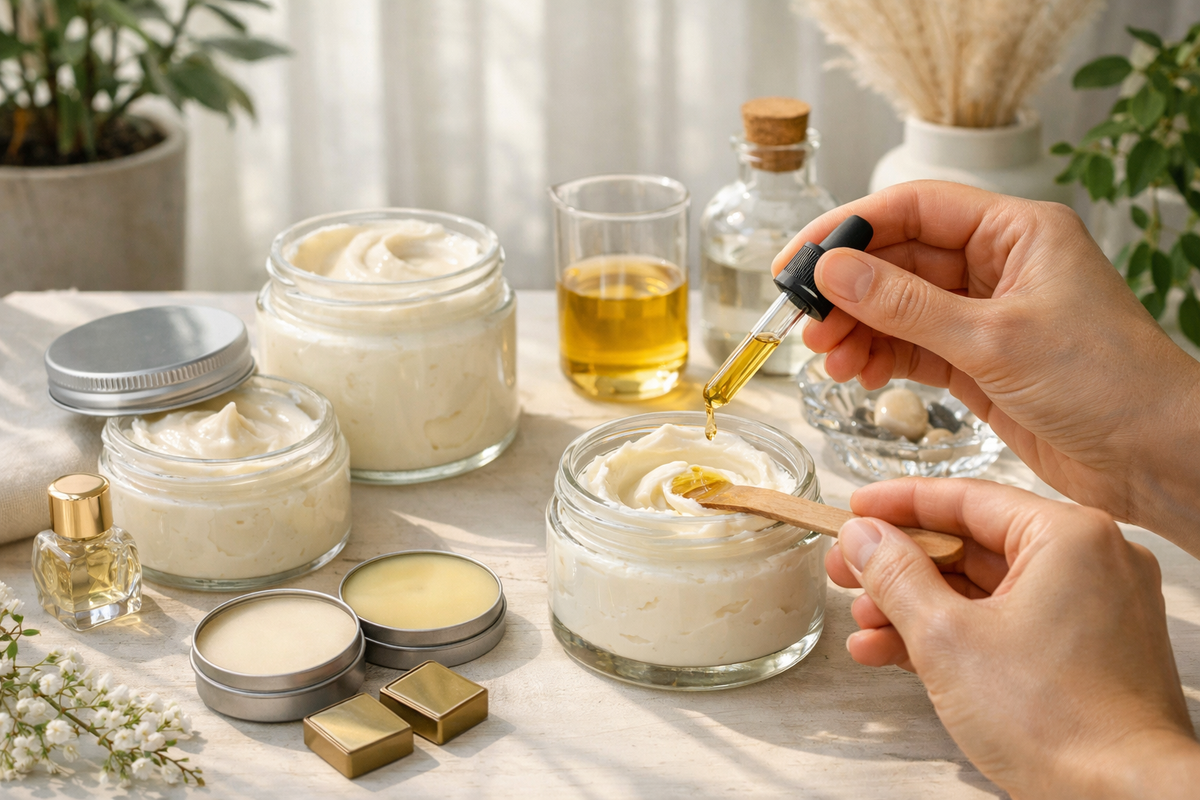
A fragrance may smell perfect on its own, but that does not mean it will work the same way in body butter, lotion, or solid perfume. Some oils are made for candles or soaps, while others are suitable for products applied to the skin. Using the wrong one, or adding more than the recommended amount, can affect the product and may cause skin irritation.
You can use fragrance oil in body butter, lotion, and solid perfume, but you need to choose the right oil first. Check its IFRA certificate to find out whether it is suitable for your product and how much you can use. Weigh the fragrance in grams rather than guessing the amount, and test the finished product before using it. Even a properly prepared product may not suit every person.
At SA by Saeed Anwar, you can find fragrance oils in different scent styles. However, an oil made for personal use is not automatically suitable for mixing into homemade skincare.
1. Before You Start: "Skin-Safe" Means More Than a Label
A bottle marked "skin-safe" may look like the right choice, but that label does not give you the full picture. Fragrance oils are made for different uses. An oil sold for candles or soap, for example, may not be suitable for body butter, lotion, or other products that remain on your skin.
You may come across oils described as cosmetic grade. This is useful information, but it does not mean the oil can be added to every type of skincare product. You still need to check the supplier's documents and make sure the fragrance is suitable for the product you want to make.
There are three documents worth checking before you start.
IFRA Certificate of Conformity: IFRA stands for the International Fragrance Association. Its standards set limits on how much fragrance can be used in different types of products. The certificate tells you the maximum amount allowed for the fragrance and the product category listed.
Safety Data Sheet (SDS): This sheet gives information about possible hazards, safe handling, storage, and first aid. It helps you understand what precautions to take when working with the fragrance.
Allergen Declaration: This document lists the fragrance allergens identified by the supplier. You can use this information when checking ingredients and preparing cosmetic labels.
Keep in mind that no fragrance is suitable for everyone. Some people may still react to an ingredient, even when the correct documents are available.
Before adding any fragrance to your formula, check its IFRA certificate, SDS, and allergen declaration. If the supplier cannot provide these details, it is better not to use the oil in a product that will be applied to the skin.
2. Which IFRA Category Is Your Product?
IFRA categories group products according to how people use them and their level of exposure. A fine fragrance is used differently from body lotion, hand cream or deodorant. This is why the same fragrance can have different maximum usage levels depending on the product.
Check the category that matches your finished product before using a fragrance.
|
What You Are Making |
IFRA Category |
Why It Matters |
|
Solid perfume and fine-fragrance products |
4 |
Covers fine-fragrance applications. |
|
Body lotion, body butter, body cream and body oil |
5A |
Covers leave-on body products. |
|
Face moisturiser or serum |
5B |
Covers leave-on facial products. |
|
Hand cream |
5C |
Covers leave-on hand products. |
|
Baby lotion or oil |
5D |
Covers baby-care products. |
|
Products applied to the underarms |
2 |
Covers axillary products such as deodorants. |
Limits vary by category, so you cannot use the same amount of fragrance in every product. For example, the limit given for a Category 4 fragrance does not mean you can add that same amount to body lotion or face cream.
Always choose the category that matches the product you are making. IFRA standards and category details can be updated, so check the official IFRA website for the latest information before preparing or changing your formula.
3. From Percentage to Grams: How Much Fragrance Oil to Use
If you are making lotion at home, you may wonder how much fragrance oil to use in lotion. The amount is not the same for every fragrance. It depends on the oil you have chosen and the limit listed on its IFRA certificate for that type of product.
The usage rate tells you how much fragrance oil is added to the total mixture. For example, a 1% rate means 1 g of fragrance oil in a 100 g batch. The maximum usage level is the highest amount allowed for that particular fragrance and product category. It does not mean you have to use the full amount. You can use less, but you should never go above the stated limit.
Weighing fragrance oil is better than counting drops. Drops are not always the same size. They can change with the bottle opening and the thickness of the oil. A digital scale makes it easier to measure the amount accurately and get similar results each time.
Use this simple formula:
Fragrance oil (g) = Batch weight (g) × Usage rate (%) ÷ 100
For example, a 100 g batch at an illustrative rate of 1% requires 1 g of fragrance oil.
|
Product (Illustrative) |
Batch Weight |
Rate Used |
Fragrance Oil Needed |
|
Body lotion |
100 g |
1% |
1.0 g |
|
Body butter |
100 g |
2% |
2.0 g |
|
Solid perfume |
30 g |
15% |
4.5 g |
|
Solid perfume batch |
100 g |
20% |
20.0 g |
These figures explain the calculation only. They are not approved usage rates for every fragrance.
Leave-on body products often have lower permitted fragrance levels than fine-fragrance products. Always use the certificate for your specific oil and the correct category. This is the key to calculating a fragrance oil usage rate in grams without treating an example as a universal formula.
4. Scenting Whipped Body Butter
Whipped body butter is often made with fats and oils rather than water. A formula without added water is called anhydrous. Common ingredients include shea butter and a liquid carrier oil, such as jojoba, which affects the final texture.
Choose a fragrance only when its supplier documentation supports the intended leave-on body application. A fragrance that smells pleasant in the bottle may develop differently when mixed into a rich base.
Pay attention to the cool-down stage. Adding fragrance while the mixture is very hot may affect the way its scent develops. Follow the base and fragrance suppliers' temperature instructions, then add the measured fragrance at the recommended stage and mix evenly.
Whipping also affects the final texture. If the mixture is too warm, it may not hold the air added during whipping. Uneven cooling can also lead to a grainy result. Follow a tested base method and assess a small batch before preparing more.
Warm weather in Pakistan is another consideration. Body butter may soften when stored in a hot room or direct sunlight. Keep the finished product in a closed container away from heat. Allow the fragrance time to settle before judging its final scent.
5. Scenting Lotion: Why Water Changes the Rules
Most lotions contain water and oil. These ingredients form an emulsion, which is a mixture designed to stay evenly blended. Fragrance oil must be compatible with the formula, as an unsuitable material can affect the lotion's texture and stability.
Follow the instructions provided with the lotion base. Some formulations allow fragrance to be added during the cool-down phase, after the mixture has been prepared and cooled to the recommended temperature. Add it gradually while mixing as directed.
Knowing when to add fragrance oil to lotion depends on the base manufacturer's instructions. Do not copy a temperature from another recipe because different formulations may have different requirements.
Adding too much fragrance can affect the lotion's consistency. It may become thinner, look oily or develop an uneven texture. Start with a small trial and observe the finished mixture before preparing a larger quantity.
Another important point is preservation. Any lotion containing water needs a suitable preservative, whether or not fragrance has been added. Fragrance oil cannot replace a preservative or prevent microbial growth. Use a compatible preservation system according to its supplier's instructions, and keep the finished lotion in clean, suitable packaging.
6. Making Solid Perfume With Fragrance Oil
Solid perfume with fragrance oil is usually made by combining wax and oils to create a product that holds its shape. Beeswax is a common structuring ingredient, while liquid oils help soften the mixture and make it easier to spread.
Before preparing the base, check that the fragrance documentation supports its use in fine-fragrance products. Solid perfume generally falls under IFRA Category 4, but the certificate for your specific fragrance determines its maximum permitted level.
Combine the wax and oil according to the base recipe. Once the mixture is melted and ready to cool, add the measured fragrance at the stage and temperature recommended by the supplier. Adding fragrance shortly before pouring can limit unnecessary heating, but the correct temperature depends on the materials.
Mix gently so the fragrance spreads evenly throughout the base. Pour the mixture into clean, dry tins or suitable containers and allow it to set without disturbance.
Heat can affect delicate fragrance notes, especially when the mixture remains warm for too long. The finished scent may therefore differ from the first smell. Give the product time to settle before assessing it, and record any changes in your batch notes.
7. Why Your Scented Base Smells Different Tomorrow
A scented product may smell or look different after it has rested. Fragrance materials interact with the base, and the first smell immediately after mixing may not represent the final result. A short maturing period can help you assess the scent, but unexpected changes should never be ignored.
|
Symptom |
Likely Cause |
What to Try |
|
Scent smells weak after a day |
Base may have been too hot, rate may be low, or scent may still be developing. |
Follow supplier cool-down guidance and allow a few days before judging. |
|
Scent changes or turns sour |
An ingredient may be old or unsuitable. |
Test a small batch with fresh ingredients. |
|
Base darkens or yellows |
Some fragrance components cause discolouration over time. |
Check the oil's data sheet and observe a small batch. |
|
Lotion separates or looks oily |
The emulsion may not support the added fragrance. |
Review the base instructions and compatibility. |
|
Butter or solid perfume melts |
Warm storage or a soft base may be responsible. |
Store away from direct sunlight and heat. |
|
Skin feels irritated |
Sensitivity to an ingredient or unsuitable finished product. |
Stop using it and seek professional advice if needed. |
Keep your containers closed and away from sunlight, heat, and damp conditions. Record the product's appearance and scent when first made, then compare it after 24 hours and later.
If a product develops an unusual smell, visible growth, or an unexpected texture change, stop using it. Do not try to hide these changes by adding more fragrance.
8. Patch Testing the Finished Product
Testing a fragrance oil alone does not tell you how the complete body product will behave on skin. The base contains other ingredients, and the finished mixture may have different properties. Always assess the product you actually intend to use.
Follow a careful patch test method with the finished formula. Apply it to a small area as directed by an appropriate testing protocol, record when it was applied, and observe the area for the stated period. For the complete procedure, read our guide on how to patch test a fragrance oil.
Watch for redness, itching, burning, swelling, raised bumps, rash or continuing discomfort. Stop using the product if any unwanted reaction appears. Do not cover the affected area with another fragranced product.
Seek medical advice if symptoms are severe, persistent or worsening. People with eczema, known allergies or other skin concerns should speak with a qualified healthcare professional before trying a new fragranced product. Extra care is also needed for products intended for pregnant people or children.
A patch test cannot guarantee that a person will never react, and it does not replace a professional safety assessment.
9. Choosing Fragrance Oils for DIY — and Where Oud Fits
Scent preference is only one part of choosing an oil for a DIY base. Softer woody, musky, amber, and floral profiles may be easier to blend into some formulas than very intense fragrances, depending on the base and the result you want. However, scent character does not prove cosmetic suitability. Check the supplier's documents before selecting a fragrance for a leave-on product. Browse our unisex fragrance oils collection to compare available scent styles.
Oud has a rich and distinctive scent, so it can strongly affect the character of a blend. Some oud materials or fragrance blends may also be dark, which could change the appearance of a pale base. Their composition and strength can vary, so do not assume all oud oils behave alike. A fragrance sold for wearing is not automatically approved as an ingredient in lotion or body butter. You can browse our oud oils collection, but check the intended use and supporting documents before considering any product for DIY formulation.
For anyone searching for alcohol-free perfume oil Pakistan options, it helps to separate choosing a fragrance to wear from choosing a material to add to a cosmetic formula. A perfume oil or attar may be sold for personal fragrance, but that does not establish its cosmetic grade or permitted use in another product.
If you are unsure, ask the supplier for the IFRA certificate, SDS, and allergen declaration. Do not describe an oil as suitable for DIY skincare unless the brand has confirmed its intended use.
10. If You Plan to Sell What You Make
Making a scented product for personal use is different from selling it to customers. A commercial product needs appropriate safety checks, accurate labelling, and records that help you trace each batch.
Before selling, pay attention to these areas:
● Labelling and allergens: Prepare an accurate ingredient list and include fragrance allergen information where required.
● Safety assessment: Have the finished formula assessed by a qualified professional. The fragrance certificate does not approve the complete cosmetic.
● Stability and quality: Check that the product maintains its appearance, smell, and texture. Water-based products also need appropriate microbiological controls and testing.
● Batch records: Record ingredient names, suppliers, weights, fragrance rate, certificate details, and preparation dates.
● Local rules: Check the cosmetic requirements in the country where you intend to sell.
Requirements differ between countries and can change. This is not legal advice. Speak with a qualified cosmetic safety or regulatory professional before selling a homemade product.
Final Thoughts
Learning how to scent body butter with fragrance oil takes more than choosing a fragrance that smells good. Check the supplier's documents, identify the correct product category, weigh the amount carefully and keep a record of every batch. Assess the finished formula and stop using it if your skin reacts or the product changes unexpectedly.
Frequently Asked Questions
Is fragrance oil the same as essential oil or perfume oil?
No. Essential oils come from plants through processes such as distillation or pressing. Fragrance oils are blends of aromatic materials, which may be natural, synthetic or both. Perfume oil or attar is a concentrated, alcohol-free fragrance made for wearing. Each has different documentation and usage requirements.
Can I scent lotion with alcohol-based perfume?
It is generally not recommended. Alcohol-based perfume is made for its intended application, not necessarily for mixing into lotion. Its alcohol content may affect the lotion's texture and may contribute to dryness or irritation. Choose a fragrance documented for the intended cosmetic application.
How long does scented butter or solid perfume last?
Its usable life depends on the ingredients, preparation, packaging, and storage. Keep it sealed and away from heat and sunlight. Make smaller batches while learning how a formula behaves. Discard the product if it develops an unusual smell, visible growth, or an unexpected change in texture.
Can I add oud oil to face cream or serum?
Do not add it unless the supplier's documents support the exact facial application and the finished formula has been assessed. Face products have their own IFRA category and limits. An oil suitable for body products may not be suitable for facial use.
What equipment do I need beyond a scale?
You may need heat-safe containers, clean mixing utensils, a suitable thermometer and clean, sealed jars or tins. Keep labels ready to record the date, ingredients, and measurements. Clean and sanitise equipment using a suitable method, then allow it to dry before use.
If you are exploring alcohol-free fragrance oils, browse the SA by Saeed Anwar range and check the intended use with the supplier before choosing an oil for a DIY project.


